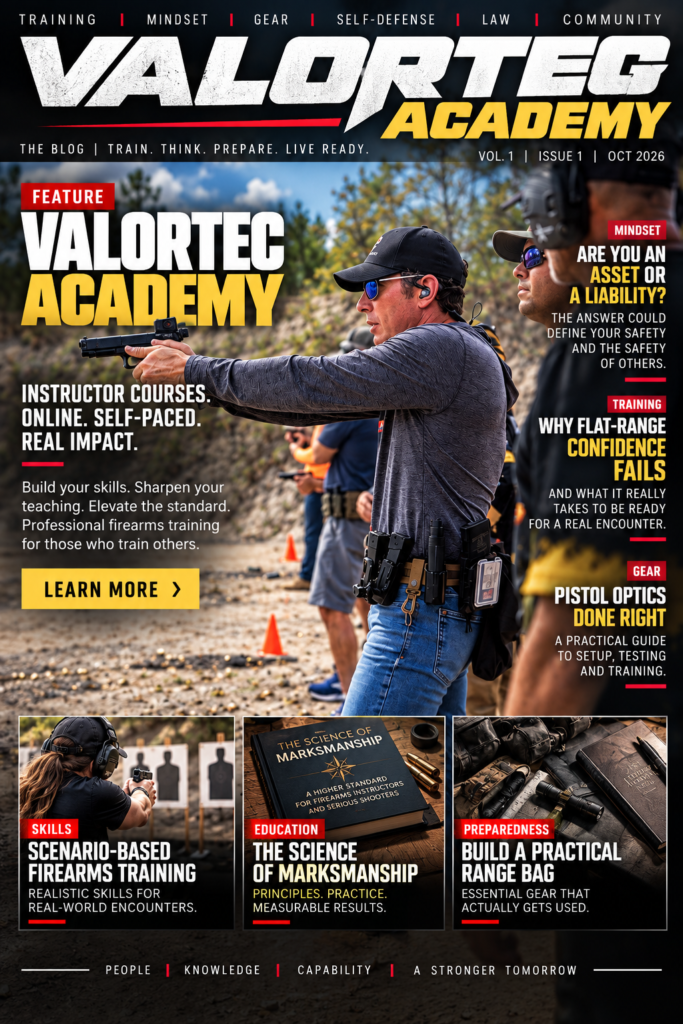
Training builds knowledge, thinking informs judgment, and preparation creates safer habits. Here is why responsible firearms education needs all three.
Tactical Edge / Feature Story

Tactical Edge / Feature Story
Training builds knowledge, thinking informs judgment, and preparation creates safer habits. Here is why responsible firearms education needs all three.
There is a difference between collecting information and being prepared to use good judgment. One is easy to display. The other depends on habits that rarely attract attention: seeking proper education, recognizing uncertainty, preventing escalation, and preparing for ordinary responsibilities before emergencies occur.
Training should begin with clear safety expectations, qualified supervision, and goals appropriate for a student’s background. Its purpose is not simply to complete a course or accumulate range time. It should help the learner understand basic responsibilities, receive useful feedback, and identify realistic next steps.
Valortec has repeatedly challenged the assumption that a gun purchase, course certificate, or social-media following proves competence. That challenge applies equally to new owners and experienced shooters. Genuine education should make people more thoughtful about the limits of their own skills.
Responsible decision-making includes the ability to recognize when disengagement, communication, de-escalation, or seeking help is more appropriate than confrontation. Understanding the law matters, but judgment also requires respecting uncertainty and considering the safety of other people.
A person who can perform a task on demand has not automatically demonstrated the ability to choose when the task should be avoided. Training programs should create space for discussing alternatives, ethical responsibilities, and the consequences of premature or unnecessary action.
Preparation includes safe storage, preventing unauthorized access, maintaining equipment appropriately, reviewing legal requirements, and planning how family members will handle emergencies. It also involves ordinary personal and organizational readiness: reliable communication, clear expectations, and the willingness to ask for help.
Consistency matters more than occasional intensity. Revisiting educational materials, seeking supervised refreshers where appropriate, and reconsidering assumptions are useful long-term habits. The goal is to reduce the distance between what one believes and what one can safely demonstrate.
Training without thought can become mechanical repetition. Thought without preparation can remain an abstract opinion. Preparation without continued learning can grow stale. The three disciplines reinforce one another, and none is a one-time checkbox.
This standard is equally relevant to civilians, security professionals, instructors, and organizations—although the legal obligations and training requirements differ. Every audience benefits from people who recognize their responsibilities and refuse to equate enthusiasm with expertise.
Train to learn. Think before acting. Prepare so responsible choices become routine. The value is not the slogan itself, but the standard of conduct behind it.
Explore more Tactical Edge cover stories · Return to the magazine